American Ingenuity, Engineered to Scale: How US Robotics Startups Are Defining the Next Decade of Automation
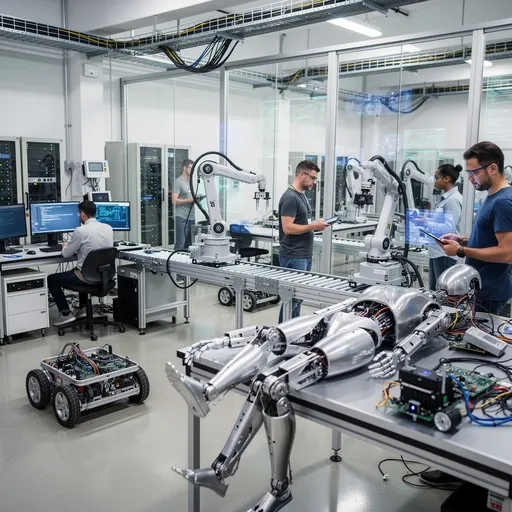
Photo: robotics startup lab engineers working on advanced robot prototype, via images.stockcake.com
For much of the past decade, the narrative around global robotics competition defaulted to a familiar frame: China was scaling manufacturing capacity at an extraordinary pace, investing heavily in industrial automation, and positioning its domestic champions for international expansion. That framing captured something real. But it also obscured a parallel story developing in American research labs, startup garages, and venture-backed engineering teams — one that is now becoming impossible to ignore.
Across sectors as varied as minimally invasive surgery, precision agriculture, and next-generation soft robotics, US-based companies are not merely keeping pace. In several critical domains, they are establishing technical leads that will be difficult for any competitor to close within a five-year horizon.
Where American Startups Are Building Advantages
Surgical Robotics: Precision at Scale
The surgical robotics sector represents one of the clearest illustrations of sustained American technical leadership. Intuitive Surgical's da Vinci platform established the commercial template for robotic-assisted procedures more than two decades ago, and the competitive ecosystem it helped create has continued to produce sophisticated challengers and adjacents.
Companies such as Vicarious Surgical, which uses a single-port system and virtual reality interface to give surgeons unprecedented spatial awareness inside the body, and Asensus Surgical, which is integrating machine learning performance data into procedural guidance, are expanding the definition of what surgical automation can accomplish. Meanwhile, Moon Surgical's Maestro system — designed specifically to augment laparoscopic procedures rather than replace them — reflects a broader trend toward collaborative human-robot surgical models that reduce procedure complexity without demanding full system replacement.
The addressable market here is substantial. The global surgical robotics market is projected to exceed $14 billion by 2028, and US companies hold the dominant position in both installed base and active development pipeline. For engineers working in medical device integration, motion planning under constraint, or haptic feedback systems, this sector represents one of the most technically demanding and commercially consequential areas of active development.
Agricultural Automation: Intelligence in the Field
American agriculture has always been a domain of mechanized innovation, and the current generation of robotics startups is extending that tradition into territory that would have seemed implausible even five years ago. The challenge is not simply replacing manual labor — it is deploying autonomous systems capable of operating in unstructured, variable, and weather-dependent environments at the scale of commercial farming operations.
Sarcos Technology, Bear Flag Robotics (acquired by John Deere), and Burro are among the companies addressing different nodes of the agricultural automation stack, from autonomous tractor guidance to inter-row transport to selective harvesting. Arguably the most technically ambitious work is happening in selective harvesting robotics — systems that must perceive, classify, and manipulate individual pieces of produce in real time across unpredictable canopy geometries. Startups including Tortuga AgTech and Harvest CROO Robotics are pushing the boundaries of what computer vision and compliant manipulation can achieve in field conditions.
The policy environment has become increasingly supportive. USDA grant programs targeting agricultural technology, combined with state-level precision agriculture initiatives in California, Iowa, and Florida, are creating funding pathways for early-stage teams that previously had to rely almost entirely on venture capital or strategic partnership with large agricultural equipment manufacturers.
Soft Robotics: Rethinking What a Robot Can Be
Perhaps the most conceptually distinctive area of American robotics innovation is soft robotics — a field that challenges the assumption that effective robotic systems must be built from rigid, high-tolerance components. By engineering actuators and end effectors from compliant materials, soft robotics researchers and startups are creating systems capable of interacting safely with fragile objects, irregular geometries, and human bodies in ways that conventional industrial robots cannot.
Soft Robotics Inc., before its acquisition by Advanced Farm Technologies, developed pneumatic grippers that could handle produce, baked goods, and packaged goods across a single production line without retooling — a capability that collapses changeover costs dramatically. Soft Robotics' underlying approach has influenced a generation of subsequent developers working on everything from wearable rehabilitation devices to underwater manipulation systems.
The broader research ecosystem feeding this commercial pipeline is anchored by institutions including Harvard's Wyss Institute, MIT's Computer Science and Artificial Intelligence Laboratory, and Carnegie Mellon's Robotics Institute — all of which maintain active soft robotics research programs with strong industry collaboration tracks.
The Funding Landscape
American robotics startups raised approximately $6.7 billion in venture capital in 2023, a figure that, while moderated from the peak years of 2021 and 2022, reflects sustained institutional confidence in the sector's long-term trajectory. More significant than total volume is the distribution of that capital: later-stage rounds are becoming larger and more concentrated in companies demonstrating commercial traction, while early-stage investment continues to flow into deep-tech bets across surgical, agricultural, and industrial automation.
Strategic investment from large industrials — Caterpillar, John Deere, Honeywell, and others — is increasingly complementing pure venture capital, particularly for companies whose technology has clear integration pathways into established product lines. This hybrid funding model accelerates commercialization timelines while providing startups with distribution leverage that pure venture backing cannot offer.
Government investment through DARPA, the Department of Energy's Advanced Research Projects Agency, and the National Science Foundation continues to fund foundational research that eventually flows into commercial development. The CHIPS and Science Act's provisions for technology and innovation hubs are expected to further amplify this effect, particularly for robotics companies operating in regions outside traditional venture capital geographies.
Policy as Competitive Infrastructure
The policy environment surrounding American robotics innovation has shifted meaningfully in recent years. Export controls on advanced semiconductor technology, combined with domestic manufacturing incentives under the CHIPS Act and the Inflation Reduction Act, have altered the competitive calculus in ways that benefit companies developing automation systems for American industrial customers.
For robotics engineers and developers, understanding this policy landscape is increasingly relevant — not merely as background context but as a practical factor shaping which projects receive funding, which partnerships are feasible, and which markets are accessible. Companies building systems that incorporate advanced sensing, AI inference hardware, or dual-use actuation technology must navigate an export control framework that is becoming more complex and more consequential.
The policy conversation around robotics and national security is also intensifying. Autonomous systems for logistics, infrastructure inspection, and critical facility management are being evaluated not only on technical and commercial merit but on their supply chain provenance and cybersecurity architecture. American startups that build with these considerations embedded from the outset are better positioned for government and defense-adjacent contracts that represent significant long-term revenue opportunities.
What This Means for Builders
For engineers and developers actively working in robotics, the current landscape offers a striking combination of technical opportunity and competitive urgency. The sectors where American startups are establishing leadership — surgical, agricultural, soft robotics — share a common characteristic: they require integrating mechanical design, perception, machine learning, and human-robot interaction in ways that demand broad interdisciplinary competence.
Open-source tooling, simulation environments like Isaac Sim and Gazebo, and cloud robotics infrastructure from AWS RoboMaker and Google Cloud Robotics are lowering the barrier to entry for teams building in these spaces. The developer ecosystem supporting American robotics innovation is more accessible than at any prior point in the field's history.
The question for the next generation of robotics builders is not whether the opportunity exists. It is whether they are positioned to move fast enough to claim it.