Cobots on the Clock: How American Factories Are Rethinking the Human-Machine Partnership
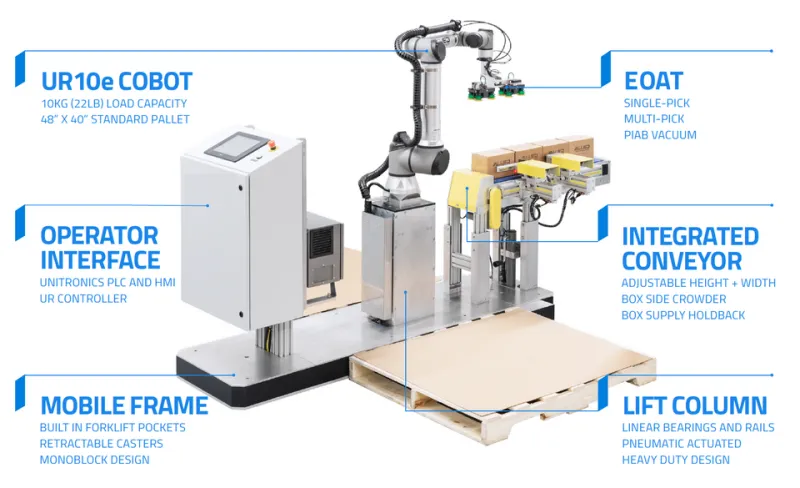
Photo: CollaborativePalletizer, CC BY-SA 4.0, via Wikimedia Commons
For decades, the dominant image of factory automation was a cage—literally. Industrial robots operated behind physical barriers, isolated from human workers for safety reasons, executing repetitive tasks at speeds no person could safely match. That paradigm is shifting. Collaborative robots, or cobots, are designed from the ground up to work alongside people, sensing proximity, adjusting force, and pausing when a human hand enters their operational radius. In 2025, this technology is no longer experimental. It is becoming infrastructure.
The Labor Equation Driving Cobot Adoption
American manufacturing is facing a workforce crisis that shows no signs of resolving itself through traditional hiring alone. According to projections from the Manufacturing Institute, the US could face a shortage of 2.1 million skilled manufacturing workers by 2030. Wages have risen sharply in response to competition for available talent, particularly in assembly, quality inspection, and material handling roles. For small and mid-sized manufacturers—those employing fewer than 500 workers—this creates a compounding pressure: higher labor costs, reduced throughput, and limited capital to fund large-scale automation.
Cobots address this problem asymmetrically. Unlike traditional industrial robots, which require substantial programming expertise, safety infrastructure, and floor space reconfiguration, modern cobots from manufacturers such as Universal Robots, FANUC, and ABB can be deployed in days rather than months. Their force-limiting designs eliminate the need for safety caging in many applications, reducing installation costs significantly. For a mid-sized electronics assembly operation in Ohio or a consumer goods packaging line in Tennessee, that difference in deployment friction is often the deciding factor.
Case Studies: Where Cobots Are Delivering Real Results
Automotive Tier Suppliers
Among the most compelling early adopters are automotive tier-one and tier-two suppliers, many of which operate in the American Midwest. A Michigan-based supplier of interior trim components integrated six cobot arms into its assembly line in 2023 to handle adhesive application and component positioning—tasks previously performed manually and subject to inconsistency. Within 14 months, the company reported a 22 percent reduction in defect rates and a return on investment that cleared the breakeven threshold in under 18 months. Critically, no workers were displaced; instead, employees were redeployed to inspection and quality assurance roles that required human judgment.
Electronics Manufacturing
In the electronics sector, precision is paramount. A contract electronics manufacturer operating in the Research Triangle region of North Carolina deployed cobots for printed circuit board (PCB) handling and soldering support. The cobots' ability to perform repeatable micro-positioning tasks with submillimeter accuracy addressed a long-standing quality bottleneck. The manufacturer noted that the cobots also reduced worker repetitive-strain injuries in those stations by eliminating sustained awkward postures—a benefit that carries downstream value in reduced workers' compensation costs.
Consumer Goods Packaging
Consumer goods companies face a different challenge: highly variable SKU counts and frequent line changeovers. A regional personal care products company in Georgia implemented a flexible cobot cell capable of handling multiple container formats without mechanical retooling. The system's vision-guided pick-and-place functionality allowed the line to switch between product types in under 20 minutes, compared to a previous average of two hours. For a sector where seasonal demand spikes are common, that agility translates directly into revenue capture.
The ROI Timeline: What Small and Mid-Sized Manufacturers Need to Know
Return on investment for cobot deployments varies considerably based on application complexity, labor costs in the relevant geography, and the level of integration support required. However, industry data suggests that straightforward deployments—material handling, machine tending, simple assembly—typically achieve payback periods between 12 and 24 months for US manufacturers paying prevailing wages.
For smaller operations, the calculus is more nuanced. Upfront costs for a single cobot arm, including end-of-arm tooling, safety assessment, and integration support, can range from $35,000 to $80,000 depending on the application. Federal and state-level manufacturing incentives, including provisions within the CHIPS and Science Act ecosystem and various state economic development programs, can offset a portion of that investment. Still, access to capital and the availability of qualified integration partners remain meaningful barriers for manufacturers in rural or underserved industrial regions.
Why the US Lags Behind—and What It Will Take to Catch Up
Despite the compelling case for cobots, the United States trails Germany, Denmark, Japan, and South Korea in robot density—measured as robots per 10,000 manufacturing workers. The International Federation of Robotics consistently places the US outside the top five in this metric, a ranking that has remained stubbornly static despite growing awareness of automation's benefits.
Several structural factors contribute to this gap. First, American manufacturing is more fragmented than its European counterparts, with a higher proportion of small businesses that lack dedicated automation engineering staff. Second, the US has historically relied on workforce flexibility—including immigration-driven labor supply—as an alternative to capital investment in automation. Third, cultural attitudes toward automation in labor relations have, in some instances, created friction between management and workforce over cobot deployments, even when job displacement was not the intended outcome.
Catching up will require a coordinated response. Workforce development programs that train technicians to deploy and maintain cobots—rather than simply operate them—are essential. Community colleges and technical institutes in states like Texas, Michigan, and South Carolina have begun developing robotics technician curricula, but scaling those programs nationally remains a work in progress. Industry consortia, including the Association for Advancing Automation (A3), are advocating for standardized safety frameworks that reduce the compliance burden on smaller manufacturers.
Perhaps most importantly, the narrative around cobots must shift from displacement to augmentation. Manufacturers who have successfully integrated cobots consistently report that the technology works best when workers are involved in the deployment process—contributing institutional knowledge about workflow, identifying edge cases that engineers would miss, and ultimately becoming advocates for the technology rather than its opponents.
The Road Ahead
The American manufacturing sector is at an inflection point. Labor market pressures, reshoring momentum driven by supply chain resilience concerns, and the increasing affordability of cobot technology have created conditions that favor accelerated adoption. The question is no longer whether cobots belong on the American factory floor—the evidence is unambiguous that they do. The question is whether the ecosystem of financing, training, integration support, and workforce engagement can mature quickly enough to allow US manufacturers to compete with rivals who have been building this capability for a decade longer.
For engineers and developers working at the intersection of robotics and industrial automation, the opportunity is substantial. The factories of the next decade will not be defined by robots replacing humans or humans resisting robots—they will be defined by the quality of the collaboration between the two.