Seeing Is Not Believing: Why Industrial Robot Vision Still Breaks Down on the Factory Floor
A seasoned assembly technician can glance at a conveyor belt loaded with chrome-finished components under flickering warehouse lighting and immediately identify a misaligned part. A state-of-the-art robotic vision system, trained on thousands of carefully curated images, may freeze entirely under the same conditions. That gap—between what human perception handles effortlessly and what machine vision struggles to manage—remains one of the most consequential unsolved problems in industrial automation.
For engineers deploying robotic systems across American manufacturing facilities, the stakes are not abstract. Vision failures translate directly into line stoppages, mishandled parts, downstream quality defects, and costly manual interventions. Understanding precisely why these failures occur—and what emerging technologies are beginning to address them—has become a technical priority that no serious robotics program can afford to overlook.
The Lab-to-Floor Disconnect
Most computer vision models powering industrial robots today are developed under conditions that bear little resemblance to real-world production environments. Training datasets are typically assembled in controlled settings: consistent overhead lighting, clean backgrounds, uniform part orientations, and predictable material properties. These controlled conditions yield impressive benchmark scores. They do not, however, prepare a system for the visual chaos of an active factory floor.
The moment a trained model encounters a production environment, it faces a cascade of variables its training never anticipated. Lighting shifts throughout the day as sunlight enters through skylights or loading dock doors. Dust and moisture accumulate on camera lenses. Parts arrive in orientations that deviate from training samples by just enough degrees to confuse a classifier. And then there is the persistent, maddening problem of reflective surfaces.
Chrome, polished aluminum, stainless steel, and glossy plastics are ubiquitous in American manufacturing—and they are the natural enemies of standard RGB camera systems. Specular reflections scatter light unpredictably, creating false edges, obliterating surface detail, and producing depth estimation errors that cause robotic arms to miss pick points by fractions of an inch. Fractions that, at scale and speed, become an operational liability.
Occlusion, Clutter, and the Limits of a Single Viewpoint
Beyond surface properties, occlusion poses a structural challenge that no amount of model training fully resolves. In bin-picking applications—among the most common vision-dependent tasks in warehousing and manufacturing—parts are rarely presented in isolation. They are stacked, overlapping, partially hidden beneath one another, and tumbled into configurations that vary with every cycle.
Human workers draw on stereoscopic depth perception, tactile feedback, and intuitive spatial reasoning to navigate these scenarios. They reach into a bin, feel resistance, adjust their grip, and extract a part without needing to see it completely. Robotic systems relying on a single RGB-D camera lack that redundancy. A partially obscured object that a person would recognize from context becomes, to a vision algorithm, an ambiguous cluster of pixels that may not match any known object class with sufficient confidence to act.
Some facilities have addressed this by adding multiple camera angles, but the computational overhead of fusing multiple video streams in real time introduces latency—and latency, in high-throughput environments, is its own form of failure.
Material Variability: The Problem No Dataset Fully Solves
Manufacturing environments also deal in material variability that static training sets cannot capture. A batch of injection-molded plastic housings may arrive from a supplier with a slightly different surface finish than the previous batch—not enough to matter to a human inspector, but enough to shift the reflectance profile that a vision model has learned to associate with a correctly formed part. Similar issues arise with natural materials: wood grain, fabric weave, and food products introduce organic variability that is genuinely difficult to model exhaustively.
Engineers at facilities producing consumer goods and packaged foods have reported that their vision systems require retraining or recalibration after supplier changes, seasonal shifts in raw material properties, or even changes in ambient humidity that affect how certain surfaces appear under infrared illumination. The maintenance burden this creates is substantial—and it represents a hidden cost that rarely appears in the initial ROI projections used to justify automation investments.
Emerging Approaches: Event-Based Sensors and Multi-Spectrum Imaging
The engineering community has not been passive in the face of these challenges. Two technology categories in particular are drawing significant attention as candidates for making robotic vision genuinely robust in industrial settings.
Event-based cameras, originally developed for neuromorphic computing research, represent a fundamental departure from conventional frame-based imaging. Rather than capturing full image frames at fixed intervals, event-based sensors respond asynchronously to changes in light intensity at individual pixels. The result is a sensor that generates data only when the visual scene changes, with microsecond temporal resolution and dramatically reduced susceptibility to motion blur and lighting transients. For high-speed pick-and-place operations or environments with rapidly shifting illumination, the advantages are significant. Several American robotics startups and university research groups are currently integrating event-based sensors into industrial vision pipelines, with early results suggesting meaningful improvements in tracking accuracy under challenging lighting.
Multi-spectrum imaging offers a different solution to a different subset of problems. By capturing data across wavelengths beyond the visible spectrum—near-infrared, shortwave infrared, and in some cases thermal imaging—multi-spectrum systems can extract surface information that RGB cameras miss entirely. A polished metal component that defeats an RGB camera through specular reflection may present clearly distinguishable features under near-infrared illumination. Food inspection systems that struggle to identify subsurface defects visually have found that shortwave infrared reveals moisture content and structural anomalies invisible to conventional cameras.
The tradeoff is cost and complexity. Multi-spectrum camera systems remain significantly more expensive than standard industrial cameras, and the software infrastructure required to process and fuse data from multiple spectral bands adds engineering overhead. As manufacturing automation scales across more industry sectors, however, the economic case for these investments is strengthening.
Structured Light, AI-Guided Calibration, and the Role of Synthetic Data
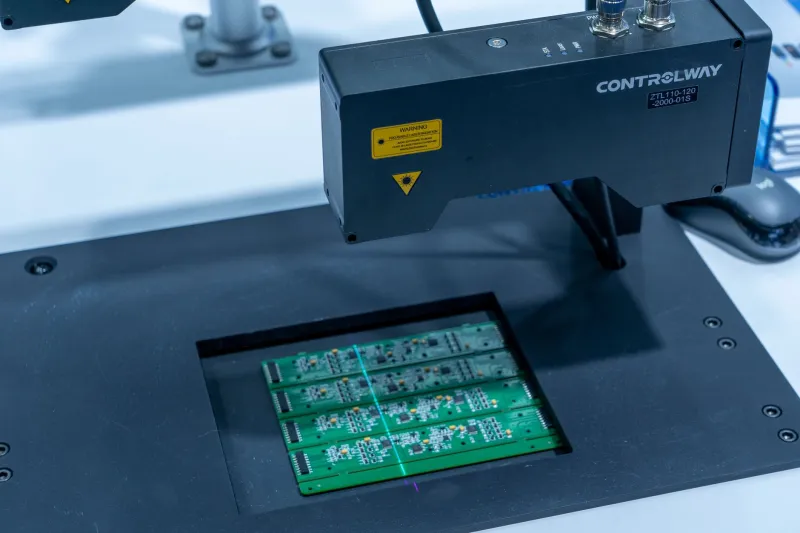
Beyond sensor hardware, software-side innovations are also narrowing the gap between laboratory performance and factory-floor reliability. Structured light projection—in which a known pattern of light is projected onto a scene and the distortion of that pattern is used to compute precise 3D geometry—has become more accessible and more accurate as projector hardware has improved. When combined with modern deep learning–based reconstruction algorithms, structured light systems can generate reliable depth maps even on reflective or texturally ambiguous surfaces.
Synthetic data generation is another avenue gaining traction. By rendering photorealistic 3D simulations of factory environments—complete with variable lighting, surface imperfections, and randomized part orientations—engineers can produce training datasets that expose vision models to edge cases that would be prohibitively expensive to capture in the real world. Several industrial automation vendors are now offering synthetic data pipelines as a standard component of their vision system development toolchains.
AI-guided self-calibration, in which a vision system continuously monitors its own performance metrics and triggers recalibration routines when accuracy degrades, is also entering commercial deployment. Rather than relying on scheduled maintenance windows, these systems adapt in near real time to environmental drift—reducing the manual intervention burden that has historically made vision-dependent automation expensive to sustain.
A Problem Worth Solving
The persistence of robot vision failures in industrial settings is not a sign that the technology is fundamentally flawed. It is a sign that the problem is genuinely hard—harder, in many respects, than the benchmark-chasing that dominates academic computer vision research would suggest. Human visual perception is the product of hundreds of millions of years of evolutionary refinement operating across a sensory system of extraordinary complexity. Replicating even a fraction of that capability in a machine, reliably, across the full range of conditions found on an American factory floor, is an engineering challenge of the first order.
The engineers working on event-based sensors, multi-spectrum imaging, synthetic training data, and adaptive calibration are making measurable progress. The gap between what robots see and what humans see is narrowing. Closing it entirely will require continued investment, interdisciplinary collaboration, and a willingness to move beyond the comfort of controlled laboratory conditions. For the automation sector, that investment is not optional—it is the prerequisite for everything else.