Out of the Lab and Into the Wild: Engineering Robots That Survive Contact With Reality
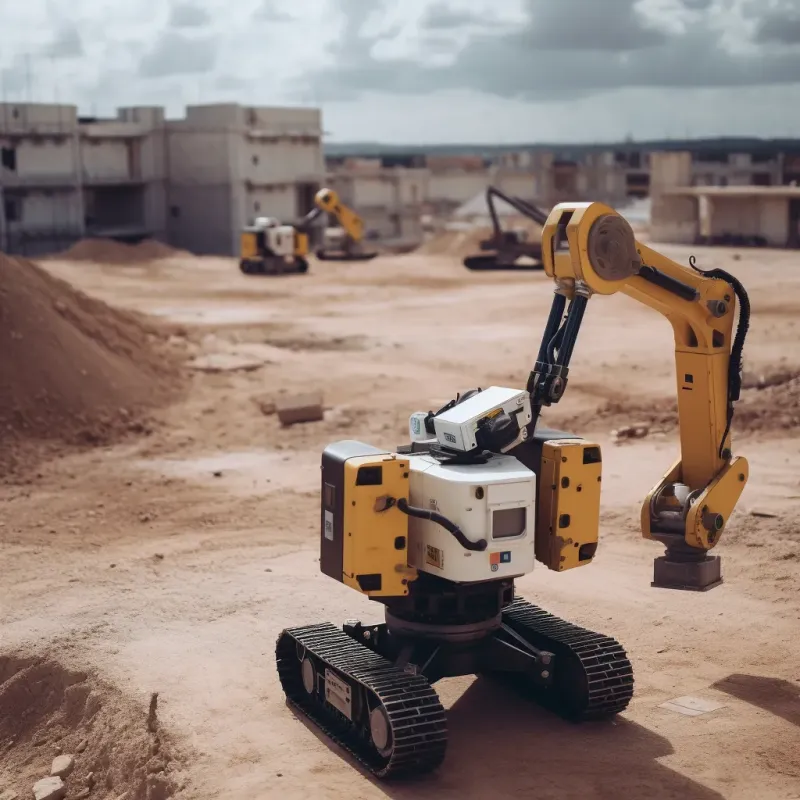
Photo: robot operating outdoors construction site autonomous navigation sensors, via www.mercuriousdevelopments.com
A robot that works in a lab is a prototype. A robot that works in the field is an engineering achievement.
This distinction, while blunt, captures a fundamental tension that every robotics engineer who has moved a system from controlled testing into production deployment will recognize immediately. The laboratory environment is an act of careful abstraction — flat floors, consistent lighting, known obstacle geometries, stable wireless connectivity, and predictable temperature ranges. The real world offers none of these courtesies.
For engineers working at the frontier of autonomous systems deployment, the transition from laboratory validation to field reliability is not a final step in the development process. It is, in many respects, where the actual engineering begins.
The Structured Environment Fallacy
Modern robotics development pipelines have become extraordinarily sophisticated at validating performance under structured conditions. Simulation platforms such as Gazebo, NVIDIA Isaac Sim, and AWS RoboMaker allow engineers to model thousands of operational scenarios before a physical prototype turns a single wheel. High-fidelity sensor emulation, physics engines, and procedurally generated environments have compressed development timelines significantly.
Yet simulation fidelity has an inherent ceiling. The so-called "sim-to-real gap" — the performance degradation a system exhibits when transferred from simulation to physical deployment — remains one of the most actively researched problems in the field. Sensor noise characteristics, surface friction variability, electromagnetic interference from co-located machinery, and the near-infinite combinatorial complexity of real-world obstacle configurations are extraordinarily difficult to replicate computationally with sufficient fidelity.
The consequence is that robots validated exhaustively in simulation frequently encounter failure modes in the field that were never anticipated in the test environment. Not because the simulation was poorly designed, but because reality is adversarial in ways that are fundamentally difficult to model in advance.
Navigation in Unstructured Spaces: The Core Challenge
Autonomous navigation in structured environments — warehouse aisles with known dimensions, factory floors with fixed obstacle maps, hospital corridors with consistent geometry — is a largely solved problem for mature platforms. The frontier lies in what researchers and engineers refer to as "unstructured environments": outdoor terrain with variable ground conditions, active construction sites with constantly reconfiguring obstacle fields, disaster zones with compromised structural integrity, and any space in which the robot cannot rely on a pre-existing map.
Boston Dynamics' Spot quadruped, deployed commercially across infrastructure inspection, mining, and public safety applications, represents one approach to this challenge. Its legged locomotion architecture allows traversal of terrain that would defeat wheeled or tracked platforms, but the perception and planning stack required to navigate dynamically changing environments demands substantial computational resources and generates its own reliability challenges.
Sarcos Technology and Robotics, headquartered in Salt Lake City, has pursued a different strategy for unstructured deployment through its teleoperated Guardian systems — offloading high-level decision-making to a human operator while preserving robotic precision and force amplification at the actuation layer. This hybrid architecture trades full autonomy for substantially improved reliability in environments where perception uncertainty is too high for safe fully autonomous operation.
The engineering insight underlying both approaches is the same: unstructured deployment requires explicit acknowledgment of the boundaries of autonomous competence and deliberate design decisions about where human judgment must be preserved.
Sensor Reliability Under Field Conditions
The sensor suites that enable autonomous navigation — LiDAR arrays, stereo camera systems, inertial measurement units, ultrasonic rangefinders — are calibrated and characterized under laboratory conditions. Field deployment subjects them to a substantially different operating reality.
LiDAR returns are degraded by rain, fog, dust, and direct sunlight in ways that vary with atmospheric conditions and cannot be fully anticipated from indoor testing. Camera-based perception systems trained on curated datasets exhibit well-documented performance degradation under lighting conditions, weather states, and object configurations outside their training distribution. IMU drift accumulates over operational periods in ways that compound localization error, particularly in GPS-denied environments.
Resilience to sensor degradation requires engineering decisions at multiple levels of the system stack. Sensor fusion architectures that maintain localization and obstacle detection capability when individual sensor modalities fail or degrade are essential for field-grade systems. Autonomous Robotics, a Massachusetts-based company developing underwater inspection platforms, has published extensively on the challenge of maintaining reliable navigation in environments where acoustic, visual, and inertial sensing are all simultaneously compromised — a scenario that would be effectively impossible to replicate in laboratory testing.
Redundancy is not a luxury in field robotics. It is a fundamental architectural requirement.
Edge Computing Constraints and the Latency Problem
Cloud-connected robotics architectures offer substantial advantages in terms of computational resources, fleet management, and over-the-air update capability. They also introduce a dependency that field environments routinely exploit: reliable, low-latency network connectivity.
In a warehouse with a managed Wi-Fi infrastructure, cloud offloading of computationally intensive perception tasks is a viable and frequently optimal architecture. On a construction site in rural Nevada, or in a disaster response scenario following a hurricane that has compromised cellular infrastructure, that architecture fails completely.
Edge computing — the deployment of sufficient processing capability on the robot platform itself to sustain safe autonomous operation without network connectivity — is consequently a non-negotiable requirement for field-grade systems. NVIDIA's Jetson platform family has become the de facto standard for onboard inference in many commercial robotics deployments, providing GPU-accelerated neural network execution within the thermal and power constraints of a mobile platform.
The engineering tradeoff is consistent: computational capability on the edge costs power, mass, and thermal management complexity. Every watt devoted to onboard computing is a watt unavailable for actuation or sensor operation. Optimizing this tradeoff for a specific deployment environment is as much systems engineering as it is software development.
Case Study Convergence: What Field-Proven Systems Have in Common
Examining American companies that have successfully transitioned robotics systems from laboratory validation to field reliability — Spot Robotics in infrastructure inspection, Marble's urban delivery platforms, Gecko Robotics' tank and boiler inspection systems, and Teledyne FLIR's defense and first-responder platforms — reveals a set of consistent engineering principles.
First, graceful degradation architectures that define explicit safe-state behaviors for every anticipated failure mode. Second, conservative operational envelopes that prioritize reliability over peak performance. Third, extensive field data collection pipelines that continuously feed real-world edge cases back into perception system retraining. Fourth, human-in-the-loop escalation paths for scenarios that exceed the system's autonomous competence boundaries.
None of these principles are technically exotic. All of them require deliberate prioritization over the performance optimization pressures that dominate laboratory development culture.
Closing the Gap
The distance between a robot that performs in a lab and one that performs in the field is not primarily a function of hardware capability or algorithmic sophistication. It is a function of engineering philosophy — specifically, the willingness to treat real-world failure modes as first-class design requirements rather than post-deployment edge cases.
As American companies continue pushing autonomous systems into logistics, construction, agriculture, and emergency response, the engineers who master the discipline of field-grade system design will define what the next generation of robotics deployment looks like. The lab is where robots are built. The field is where they are proven.