After Dark in the Heartland: How Autonomous Scrap Yards Master Chaos While America Sleeps
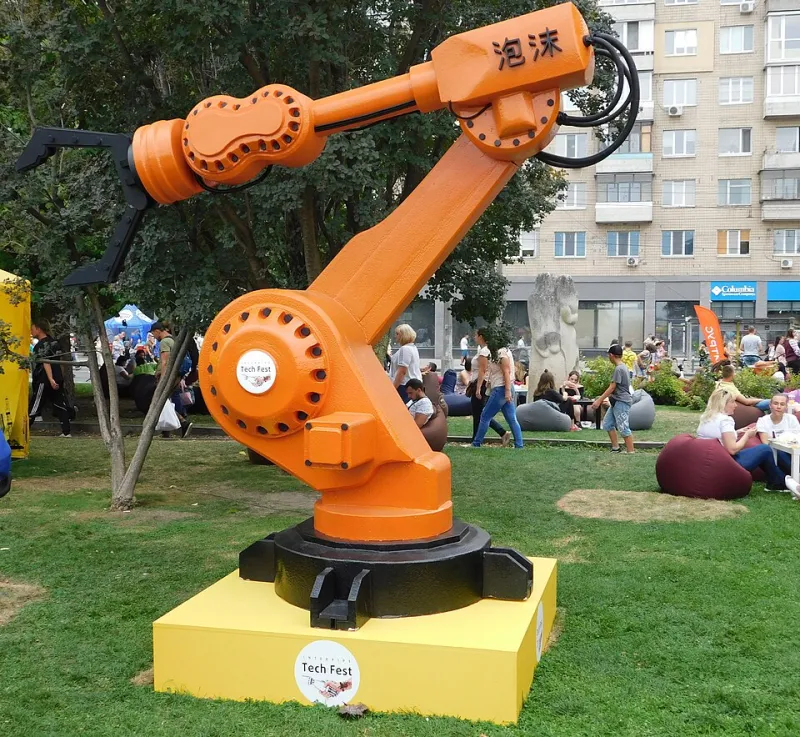
Photo: VKras, CC BY-SA 4.0, via Wikimedia Commons
At 2 a.m. on the outskirts of Gary, Indiana, a hydraulic arm the size of a school bus swings over a mountain of shredded vehicle hulks. Nobody is standing at the controls. The operator is forty miles away, watching telemetry on three monitors, sipping coffee in a home office that doubles as a control room.
This is the new face of American recycling — and almost nobody outside the industry has seen it.
The Unglamorous Frontier of Automation
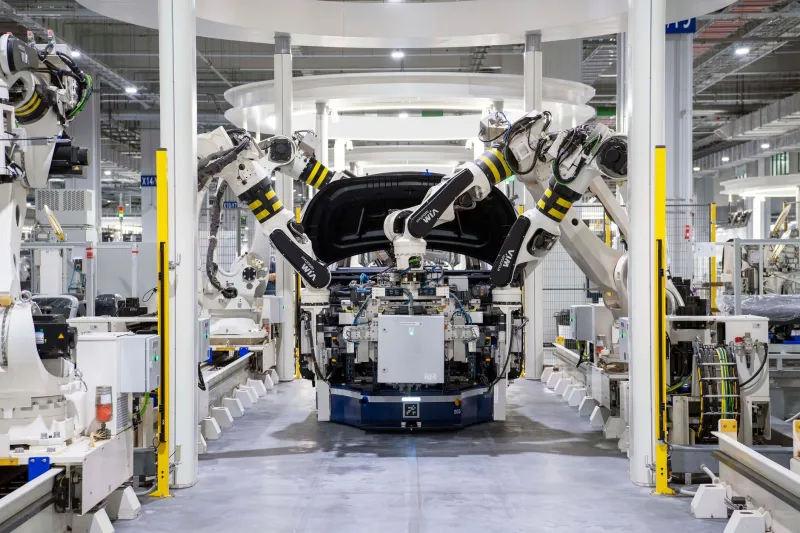
Factory robots were designed for repetition: identical parts, fixed locations, tolerances measured in microns. A scrap yard offers the opposite. Vehicle bodies arrive dented, rusted, crushed in unpredictable ways, contaminated with fluids and debris. For decades, this variability made the sector effectively off-limits to automation.
That barrier is falling. A handful of auto-disassembly and material recovery operations across Ohio, Michigan, and Indiana now run mixed robotic fleets through the night, when labor is scarce and energy rates dip. Their secret is not a single breakthrough but a stack of engineering compromises that treat chaos as the design assumption rather than the exception.
Vision Systems Built for Garbage
The core problem is perception. A car door might arrive bent 30 degrees, coated in mud, half-buried under another door. Traditional 2D machine vision fails immediately in these conditions.
The yards now deploying successfully rely on multi-modal sensing: depth cameras fused with 2D lidar and, in some installations, terahertz imaging to identify material composition through surface contamination. Classification models are trained not on curated datasets but on thousands of hours of footage from the yard itself — the muddiest, worst-case examples included.
One operator in Toledo described the philosophy bluntly: "We don't train the model on clean parts. We train it on the pile."
Grippers That Expect to Be Abused
End-effectors in these environments bear no resemblance to the delicate parallel-jaw grippers of electronics assembly. Here, the hardware of choice is overbuilt by design: hydraulic claws with replaceable wear plates, self-clearing debris channels, and torque limits tuned to fail gracefully rather than catastrophically.
Critically, these grippers are treated as consumables. Maintenance schedules are measured in days, not months, and quick-swap mounting systems let a two-person crew replace a worn claw in under twenty minutes. The economics only work because the robots run hard enough to justify the wear.
The Remote Operations Layer
What truly separates these yards from failed automation experiments of the past is the human oversight model. Rather than staffing the floor, operators supervise fleets remotely, intervening only when confidence scores drop below threshold.
This is where lessons from earlier coverage of latency and remote monitoring in industrial robotics prove out: the link between control room and machine must be engineered for intermittent connectivity, with each robot capable of safely pausing itself rather than waiting for instructions that may not arrive on time.
The result is a labor model that looks less like manufacturing and more like air traffic control — one experienced operator supervising a dozen machines, with interventions logged and fed back into the perception models nightly.
Why the Night Shift
Running autonomously overnight is not just a novelty. Energy-intensive shredding and shearing operations benefit from off-peak rates. Trucking deliveries arrive on their own schedule. And critically, mistakes made at 3 a.m. happen with no one nearby to injure.
The recycling industry has long been among America's most dangerous workplaces. Removing people from the picking line is not just an efficiency play — it is a safety intervention with measurable human stakes.
A Template for Messy Industries
The lessons radiating outward from these yards apply well beyond scrap. Any sector dealing with unstructured, contaminated, unpredictable physical material — demolition, disaster response, agriculture residue processing — faces the same fundamental problem.
The answer emerging from the Heartland is not smarter robots. It is humbler ones: machines designed to expect abuse, perception systems trained on the worst data available, and humans repositioned as supervisors rather than operators. It is automation built for the world as it actually is — dirty, dented, and arriving by the truckload at two in the morning.