The Twenty-Person Problem: Where Robot Adoption Actually Breaks Down in Small American Shops

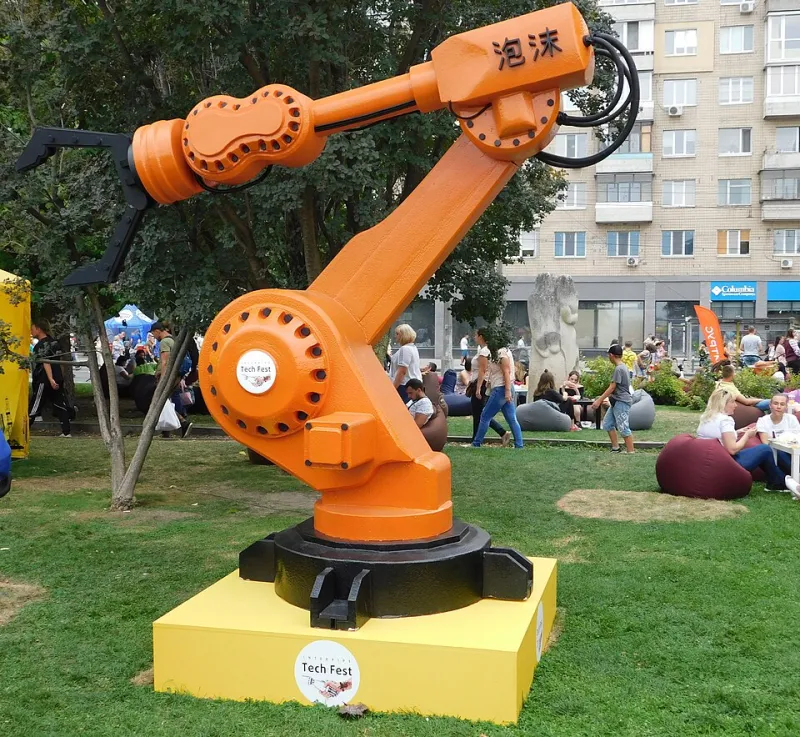
Photo: Ebyabe, CC BY-SA 3.0, via Wikimedia Commons
Walk any manufacturing trade show in this country and you will hear the same pitch: robots are finally affordable, easy to program, and essential to staying competitive. The narrative is seductive. It is also, for a large share of small American businesses, wrong — or at least dangerously incomplete.
This is not an argument against automation. It is an argument against the blanket version of it.
The Arithmetic Nobody Puts on the Brochure
A collaborative robot arm priced at $35,000 looks like a bargain next to a $65,000 annual wage. But the sticker price is the entry fee, not the bill. Integration, fixturing, end-effector tooling, safety assessment, and programming routinely push total deployment costs to three or four times the arm's price. Industry surveys have long suggested median integration costs well into six figures for first-time adopters.
Now consider the twenty-person machine shop in Wichita or the family injection molder in Lancaster County. These businesses run mixed, low-volume, high-variety work. Changeovers happen daily. The robot that justifies itself through repetition of a single task simply does not find that task often enough.
When It Doesn't Work: Three Real Patterns
Talk to operators who rolled back their automation investments and the failure modes cluster into familiar shapes.
The champion problem. A deployment succeeds because one mechanically-inclined employee owns it — troubleshooting, re-teaching, babysitting. That employee gets promoted, quits, or burns out, and the robot becomes a $40,000 coat rack. Small shops rarely have depth of technical staff to absorb this.
The utilization trap. A robot dedicated to a part family that represents 15% of revenue spends most of its life idle. The owner bought it to solve the most annoying job, not the most frequent one. Annoyance is not a business case.
The integration spiral. What the vendor demoed and what the shop floor actually contains are separated by custom fixturing, legacy machines with no digital interfaces, and workflow habits that predate the owner. Each gap costs money. Projects stall at 80% complete — permanently.
None of this is hypothetical. These are the stories that circulate quietly in peer networks like local manufacturers' extension partnerships, far from the keynote stages.
The Honest Middle Ground
Here is what the successful small-shop adopters tend to share — and it is not enthusiasm. It is restraint.
They automate the boring, ergonomically punishing, high-frequency tasks first: machine tending on the one CNC that runs every day, palletizing at end of shift, repetitive welding on a long-running contract. They buy platforms their existing maintenance staff can service. They insist on seeing the robot run their part, not a demo part. And critically, they treat the first deployment as tuition — a paid education in what their operation actually is.
There is also a quieter alternative gaining ground: renting capacity rather than owning robots. Contract machine-tending cells, robotic welding job shops, and shared automation hubs — several supported by state manufacturing extension programs — let small shops access automation by the job without carrying the fixed cost. For businesses with volatile order books, this is frequently the correct answer, and it rarely gets said out loud at industry events.
Hype Has a Cost
The danger of robot evangelism is not that small businesses waste money, though many do. It is that a failed first deployment poisons the well for a decade. The owner who lost $80,000 on a poorly scoped cobot project does not revisit automation in year three when the technology might actually fit. They become the skeptic their neighbors cite.
The robotics industry needs small businesses to succeed with automation, because that is where most of American manufacturing actually lives. That requires selling fit, not futures. Sometimes the honest answer to a shop owner is: not yet, and maybe not this.
Automation is a tool with a narrow, powerful band of applicability. Pretending otherwise helps no one — least of all the twenty-person shop just trying to make payroll and ship on Friday.