The Handoff Gap: Engineering the Moment Robots Yield Control to Humans
The Invisible Interface
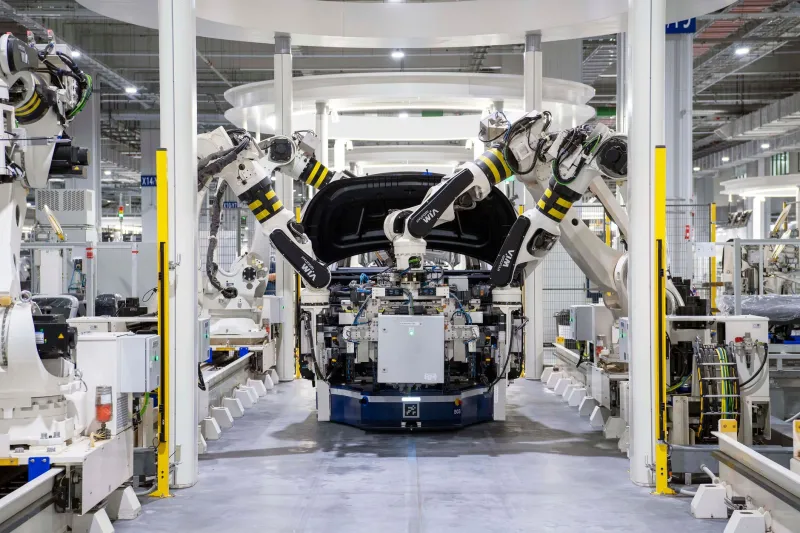
Spend enough time on the floor of a modern American distribution center or automotive assembly plant, and a pattern emerges that rarely appears in the glossy case studies published by automation vendors. The robots perform their assigned tasks with admirable precision. The human operators perform theirs with practiced efficiency. But in the space between—the moment a robot presents a component, a bin, or a completed subassembly to a waiting person—something less elegant occurs.
The worker reaches awkwardly to compensate for a poorly positioned handoff. The robot pauses longer than necessary, waiting for a confirmation signal that takes a beat too long to register. A safety zone activates, stops the robot mid-motion, and requires a manual restart. Multiply these micro-inefficiencies across thousands of handoffs per shift, and the cumulative cost—in time, ergonomic strain, and throughput—becomes substantial.
This is the handoff gap: the engineering space between what robots do and what humans do next, and it remains one of the most underinvested interfaces in industrial automation.
Why the Last Transfer Gets the Least Attention
The relative neglect of robot-to-human transition engineering is not accidental—it reflects how automation projects are typically structured and evaluated. Capital investment decisions are driven by the performance metrics of individual robotic systems: cycle time, pick accuracy, uptime percentage. The interface between those systems and the humans who work alongside them is often treated as an integration detail, addressed during commissioning rather than designed from the outset.
The result is that human-robot handoff quality is frequently an afterthought, shaped by whatever the robot's default behavioral parameters happen to produce rather than by deliberate ergonomic or safety design.
This matters more than the industry has historically acknowledged. The Occupational Safety and Health Administration (OSHA) has documented musculoskeletal injury patterns in facilities where workers repeatedly assume awkward postures to receive materials from automated systems. The ergonomic cost of a poorly designed handoff is not merely a quality-of-life issue—it is a workers' compensation liability, a productivity drain, and increasingly, a regulatory exposure.
The Engineering Dimensions of a Good Handoff
What does a well-engineered robot-to-human transition actually require? The answer spans several distinct technical domains, each with its own design challenges.
Positional and orientational accuracy is the most obvious dimension. A robot presenting a component to a human worker should place it at a height, angle, and orientation that minimizes reaching, twisting, and gripping effort. This sounds straightforward but requires detailed knowledge of the human task that follows—knowledge that is not always available to the robot integrator at the time of system design.
Velocity and force management in the final approach matters enormously. A robot that moves at full operating speed until the moment of handoff creates a collision risk and an instinctive flinch response in workers that compounds over a shift into real fatigue. Systems designed with deliberate deceleration profiles and compliant final-approach behavior are meaningfully safer and less psychologically taxing, even when the probability of actual contact is low.
Predictability and legibility of robot behavior may be the most underappreciated dimension. Human workers are extraordinarily good at reading the intentions of other humans—we interpret body language, eye contact, and movement trajectories with unconscious speed. Robots provide none of these cues, which means workers must either develop their own interpretive heuristics through experience, or receive explicit behavioral signals from the system. Indicator lights, audio tones, and motion choreography that communicates intent—slowing, stopping, presenting—all reduce cognitive load and reaction time at the handoff moment.
Safety sensing architecture around the handoff zone requires particular care. Traditional safety systems designed to stop a robot when a human enters its operating envelope are often too blunt an instrument for collaborative handoff scenarios. They treat human presence as a threat to be neutralized rather than as an event to be managed. More sophisticated approaches use layered sensing—combining lidar, vision, and force-torque feedback—to distinguish between a worker reaching to receive a handoff and a worker in unexpected proximity to a moving system.
Case Studies in Getting It Right
Several US-based manufacturers and logistics operators have begun treating handoff engineering as a first-class design problem, with measurable results.
A Midwest automotive parts supplier reported a 23 percent reduction in ergonomic incident reports after redesigning the handoff interface between its cobot assembly cells and downstream human quality inspectors. The changes were not dramatic: adjustable presentation height, a modified approach velocity profile, and a simple visual indicator that signaled handoff readiness. The capital cost was modest. The impact on worker strain and throughput was not.
A large e-commerce fulfillment operator on the West Coast embedded human factors engineers into its AMR deployment team specifically to instrument and analyze handoff interactions. Using wearable sensors to measure worker posture and reach during handoffs, the team identified three recurring ergonomic failure patterns that had been invisible in the standard operational data. Redesigned handoff zones and modified robot presentation angles addressed all three within a single commissioning cycle.
Standards and the Slow March Toward Accountability
The standards landscape governing robot-to-human handoffs is evolving, though not quickly. ISO/TS 15066, which addresses collaborative robot safety, provides a framework for managing contact forces and approach speeds but does not prescribe ergonomic design requirements for handoff interfaces. ANSI/RIA R15.06, the primary US standard for industrial robot safety, similarly focuses on hazard prevention rather than interaction quality.
Industry groups including the Robotic Industries Association (now part of the Association for Advancing Automation, or A3) have begun convening working groups to address collaborative interface standards more comprehensively. The pace of that work, however, lags behind the rate of deployment—a familiar condition in a field where technology consistently outpaces governance.
In the interim, the most effective accountability mechanism appears to be customer demand. Sophisticated automation buyers are increasingly writing handoff quality requirements into procurement specifications, asking vendors to demonstrate ergonomic performance data alongside the cycle time and accuracy figures that have historically dominated the conversation.
Designing for the Human in the Loop
The deeper issue underlying handoff engineering is a philosophical one about how collaborative automation is conceptualized. Systems designed primarily as autonomous agents that occasionally interact with humans will always treat the handoff as a boundary condition—something to be managed at the edges of the robot's operational envelope. Systems designed from the outset as components of a human-robot team will treat the handoff as a central design requirement, as important as any other performance parameter.
The factories and fulfillment centers that are getting this right share a common characteristic: they treat their human workers not as residual elements filling gaps that automation has not yet claimed, but as the performance-critical partners that, in most real production environments, they remain. Engineering the handoff well is not a concession to human limitations. It is an acknowledgment that the system includes the human, and that the system's performance depends on how well every element within it—robotic and human alike—is designed to function together.