Fingers of Failure: The Stubborn Engineering Problem at the Heart of Industrial Robotics
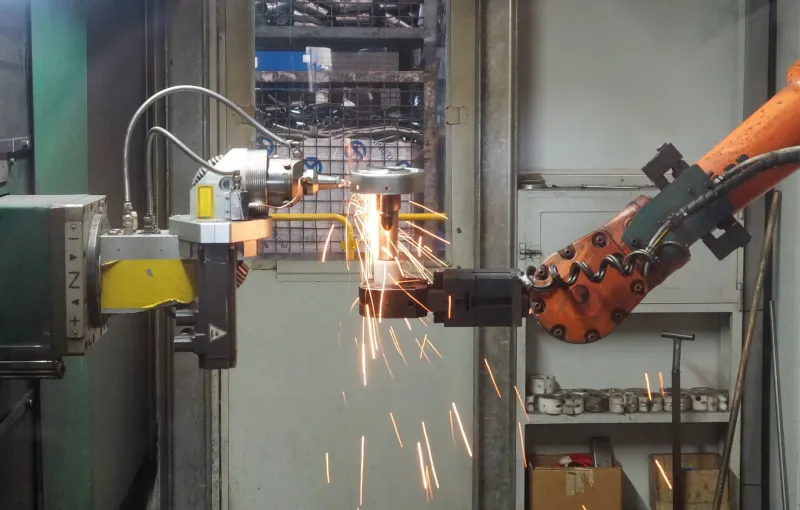
Spend an afternoon on any mid-sized American manufacturing floor and you will witness the same recurring scene: a six-axis arm executing flawless trajectories, an AI-powered vision system identifying parts with near-perfect accuracy, and then—at the very last moment—a gripper mishandling the object it was designed to hold. A widget drops. A line stops. A supervisor sighs.
The gripper paradox is this: the component that looks the most straightforward is, in practice, the hardest to get right. While the robotics industry has invested billions in machine learning, sensor fusion, and motion planning, the mechanical interface between robot and object remains stubbornly unreliable for a significant portion of real-world applications. For large original equipment manufacturers with dedicated integration teams, this is a manageable problem. For smaller American manufacturers—shops running three to fifteen robots, without in-house robotics engineers—it can be the difference between a profitable automation investment and an expensive mistake.
Why Simple Mechanics Produce Complex Problems
At first glance, a gripper seems trivially simple. It opens. It closes. It holds something. Yet the physics governing that interaction are anything but trivial.
Every gripping event involves a negotiation between force, friction, geometry, and material compliance. A gripper calibrated for a rigid steel fastener will catastrophically deform a soft silicone gasket. One tuned for a foam packaging insert will slip on a freshly machined aluminum housing. The coefficient of friction between gripper fingers and workpiece changes with surface finish, temperature, lubrication, and even ambient humidity. In a controlled laboratory environment, these variables can be isolated. On a production floor in Toledo or Tupelo, they cannot.
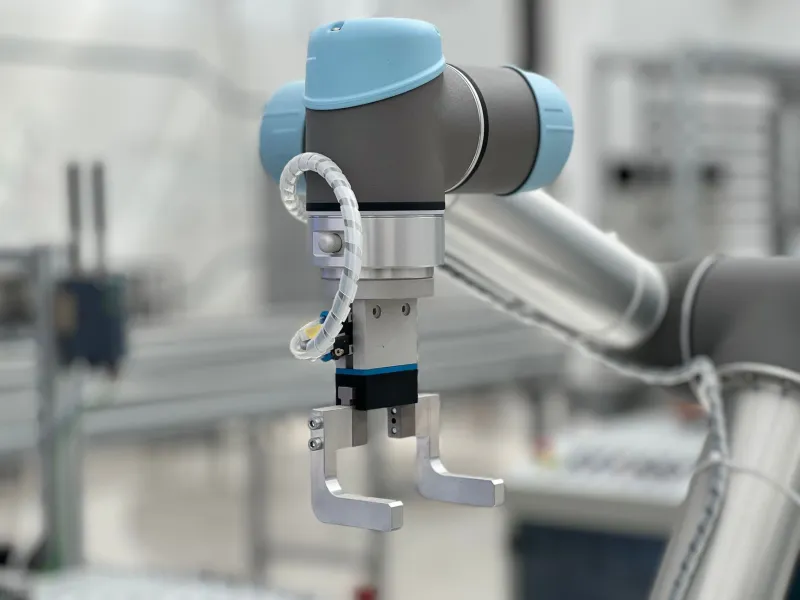
The actuation mechanism compounds the challenge. Pneumatic grippers—still the dominant design in American factories—offer speed and force but limited controllability. Electric grippers provide programmable compliance and force feedback but introduce complexity and cost that many smaller operations struggle to justify. Hydraulic designs deliver exceptional grip strength for heavy payloads but are largely impractical outside specialized industrial environments. Each actuation paradigm solves certain problems while creating others, and no single approach has achieved the versatility that general manufacturing demands.
The Material Science Gap
Finger material selection is where gripper engineering gets genuinely difficult. Hard tooling—steel or aluminum fingers—provides durability and dimensional consistency, but it transfers all compliance responsibility to the control system. If the robot doesn't know exactly how stiff or fragile the part is, hard fingers become a liability.
Soft robotics research, much of it emerging from university labs in Boston, Pittsburgh, and Pasadena, has demonstrated that compliant, elastomer-based fingers can passively conform to irregular geometries, dramatically expanding the range of objects a single gripper design can handle. The problem is durability. Silicone and polyurethane fingers that perform beautifully in a research setting often degrade within weeks under the repetitive stress of production-rate cycling. Abrasion, chemical exposure from cutting fluids and lubricants, and thermal cycling all accelerate material fatigue in ways that standard laboratory testing fails to predict.
Some manufacturers have begun experimenting with fiber-reinforced elastomers and thermoplastic polyurethane blends that offer improved wear resistance without sacrificing compliance. These materials show genuine promise, but they have not yet been validated at the scale and across the environmental diversity that American manufacturing actually presents.
Fragmentation and the Compatibility Crisis
Perhaps the most commercially damaging dimension of the gripper problem is not technical but structural. The gripper market has evolved into a fragmented ecosystem of incompatible designs, proprietary mounting interfaces, and vendor-specific control protocols. A manufacturer running a Universal Robots arm alongside a FANUC cell and a Yaskawa collaborative robot may find that gripper solutions optimized for one platform are incompatible with the others—not because of fundamental engineering constraints, but because of deliberate or incidental proprietary decisions made by competing vendors.
This fragmentation imposes real costs. Integration time increases. Spare parts inventories multiply. Technician training becomes platform-specific rather than transferable. For large automotive or aerospace primes, dedicated integration partners absorb much of this burden. For a contract manufacturer in the Midwest running a lean operation, every hour spent on gripper compatibility issues is an hour not spent on production.
Industry bodies including the Association for Advancing Automation have acknowledged the problem, and there are ongoing conversations about standardizing mechanical interfaces and communication protocols. Progress, however, has been slow. Vendors with established proprietary ecosystems have limited commercial incentive to embrace standards that would commoditize their products.
What Modular Approaches Are Beginning to Change
A small but growing cohort of startups and established suppliers are attacking the gripper problem from a modular design philosophy. Rather than engineering a single gripper for a specific application, modular systems provide interchangeable finger sets, configurable palm geometries, and standardized mechanical and electrical interfaces that allow a single base unit to be reconfigured for different part families.
Companies such as Soft Robotics, Robotiq, and OnRobot have each pursued variants of this strategy, offering tool-changer-compatible designs that reduce the cost of switching between gripper configurations during a production shift. The economic argument is compelling: instead of purchasing three application-specific grippers, a manufacturer purchases one modular platform and a library of finger sets.
The engineering argument is more nuanced. Modular systems introduce their own complexity at the interface points between components. Repeatability—the ability of a reconfigured gripper to perform identically to its previous configuration—depends on tight mechanical tolerances at every joint and connection. When those tolerances drift, as they inevitably do with wear, the performance benefits of modularity erode.
Nonetheless, the direction is encouraging. When paired with integrated force-torque sensing and adaptive control algorithms, modular grippers are beginning to demonstrate the kind of real-world versatility that fixed designs have consistently failed to achieve.
The Economic Equation for Smaller Manufacturers
For the segment of American manufacturing that stands to benefit most from reliable, affordable grippers—small and mid-sized operations with limited automation budgets—the economics remain difficult. A capable electric gripper with force feedback and a standardized interface can cost anywhere from $1,500 to $8,000, before integration. For a shop deploying its first collaborative robot at a total system cost of $60,000 to $80,000, the gripper represents a non-trivial line item, and one that frequently underperforms relative to expectations.
The National Institute of Standards and Technology has identified gripper reliability and interoperability as priority research areas, and several Department of Energy manufacturing innovation institutes have funded applied research in adaptive end-effector design. These investments will eventually produce better tools. The timeline, however, is measured in years, not quarters.
A Problem Worth Taking Seriously
The robotics industry has a tendency to celebrate its most sophisticated achievements—bipedal locomotion, autonomous navigation, large-scale multi-robot coordination—while treating the gripper as an afterthought. That framing is increasingly difficult to justify. A robotic system that cannot reliably interact with physical objects is, in most manufacturing contexts, a system that cannot do its job.
For engineers working on automation deployments, the practical implication is clear: gripper selection and integration deserves the same rigorous engineering attention as any other system component. Simulation environments that model contact mechanics, empirical testing under realistic production conditions, and honest conversations with gripper vendors about real-world performance data are not optional steps. They are the foundation of a deployment that actually works.
The gripper problem will not be solved by a single breakthrough. It will be solved incrementally, through better materials, smarter actuation, open interface standards, and a manufacturing sector that demands more from its suppliers. American industry has navigated harder engineering challenges than this one. The question is whether the urgency is finally being recognized.