From the Floor Up: How American Manufacturers Are Building Robotics Talent From Within
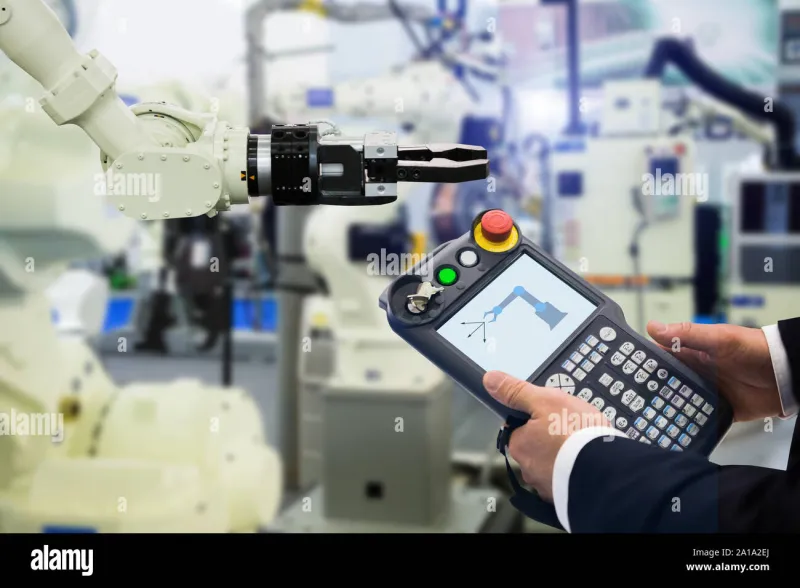
Photo: factory worker learning robotics programming on teach pendant industrial training, via c8.alamy.com
The conversation about the robotics workforce shortage tends to focus on universities, community colleges, and the pipeline of engineering graduates entering the field. That framing, while not inaccurate, misses a quieter and arguably more consequential story unfolding inside American manufacturing facilities right now. Across the country, mid-sized companies that cannot wait for formal education systems to catch up are developing their own solutions—building structured training programs, internal apprenticeships, and hands-on simulation environments designed to convert experienced production workers into capable robotics operators.
The results are uneven, the methods are varied, and the stakes are high.
The Scope of the Problem
The shortfall in qualified robotics talent is not a projection—it is a present-day operational constraint. According to industry surveys, a significant portion of US manufacturers report difficulty filling automation-related roles, a challenge that intensifies as facilities deploy more collaborative robots, automated guided vehicles, and vision-guided systems that require ongoing human oversight.
The issue is not simply a lack of engineers. It is a shortage of operators: workers who understand how to program basic tasks, interpret system alerts, perform routine calibrations, and communicate effectively with maintenance teams when something goes wrong. These roles sit between traditional line work and full mechanical engineering—a middle tier that formal education has been slow to address at scale.
For companies operating on tight margins and tighter timelines, waiting for the external talent market to correct itself is not a viable strategy.
What Corporate Training Programs Actually Look Like
At a precision parts manufacturer in the Midwest, the answer came in the form of a dedicated internal training cell—a section of the facility set aside not for production, but for practice. Workers selected for the program spend six to eight weeks rotating through structured modules covering robot teach pendants, safety protocols, basic PLC interaction, and fault diagnosis. Instruction is delivered by a combination of senior technicians and, increasingly, vendor-provided curriculum from the robot OEMs themselves.
"We were not going to find people with five years of FANUC experience walking in off the street," explained one training coordinator at the facility, who oversees a cohort of twelve trainees per cycle. "So we stopped looking for them. We started building them."
A similar model has taken hold at a contract electronics assembler in the Southeast, where the company partnered with a local community college to co-develop a twelve-week certificate program. The curriculum was designed jointly—the college provided instructional infrastructure and academic credentialing, while the manufacturer supplied equipment, real-world scenarios, and guaranteed job placement for graduates. Participants receive a modest stipend during training, reducing the financial risk that has historically deterred experienced workers from pursuing career transitions.
These hybrid arrangements are becoming more common. They allow companies to influence curriculum in ways that purely academic programs rarely permit, ensuring that graduates arrive familiar with the specific platforms, safety standards, and workflows already in use on the production floor.
Who Is Making the Transition
The profile of workers entering these programs is notably diverse. Many are long-tenured production employees in their thirties and forties who have demonstrated mechanical aptitude and a willingness to learn. Others are veterans with electronics or systems experience acquired during military service. A smaller but growing segment consists of workers displaced from adjacent industries—logistics, automotive assembly, food processing—who are actively seeking roles with stronger long-term prospects.
For many participants, the transition involves genuine personal risk. Stepping away from a familiar role to pursue retraining requires confidence that the investment will pay off. Companies that have succeeded in attracting strong candidates tend to be those that have made that value proposition explicit: defined career ladders, wage increases tied to certification milestones, and visible examples of colleagues who have successfully made the move.
"Seeing someone from your own shift become a robotics technician two years later—that changes how people think about what's possible for them," noted one HR director at a packaging equipment firm in Ohio that has run an internal upskilling program since 2021.
What Is Not Working
Not every initiative has delivered on its promise. Several companies interviewed for this piece described training programs that produced workers with theoretical knowledge but limited practical competency—graduates who could pass a written assessment but struggled to troubleshoot a live fault on a production line under time pressure.
The root cause, in most cases, was insufficient hands-on time. Simulation software and e-learning modules have genuine value as foundational tools, but they do not replicate the sensory and cognitive demands of working with physical systems in a live environment. Programs that skimped on floor time in favor of lower-cost digital instruction consistently underperformed.
Vendor-led training, while often technically rigorous, presents its own limitations. Instruction tied to a specific OEM's platform may not transfer meaningfully when a facility runs mixed-brand equipment. Workers trained exclusively on one manufacturer's interface can find themselves disoriented when asked to operate a system with a different architecture.
The most effective programs observed were those that combined platform-specific depth with broader systems thinking—teaching workers not just how to operate a particular robot, but how to reason through unfamiliar problems using first principles.
Practical Takeaways for Employers and Career-Switchers
For manufacturers considering launching or refining a training initiative, the evidence points toward a few consistent principles. First, invest in physical training infrastructure. A dedicated practice cell, even a modest one, consistently outperforms purely digital alternatives. Second, build in mentorship. Pairing trainees with experienced technicians accelerates skill development and improves retention. Third, make the career pathway visible and contractual—workers are more likely to commit to retraining when advancement milestones are clearly defined and formally recognized.
For individuals considering a transition into robotics operations, the opportunity is real but requires deliberate preparation. Familiarity with basic electrical concepts, comfort with structured troubleshooting processes, and exposure to automation platforms—even through low-cost simulation tools available online—significantly improve candidacy. Many of the programs described in this piece actively recruit from within existing workforces, meaning the first step may be a conversation with a supervisor rather than an application to an external program.
The robotics workforce of the next decade will not be built exclusively in university labs or four-year degree programs. It will be built, in substantial part, on factory floors—by companies willing to invest in the people already standing on them.