Many Machines, One Mission: How Robot-to-Robot Coordination Is Transforming American Manufacturing
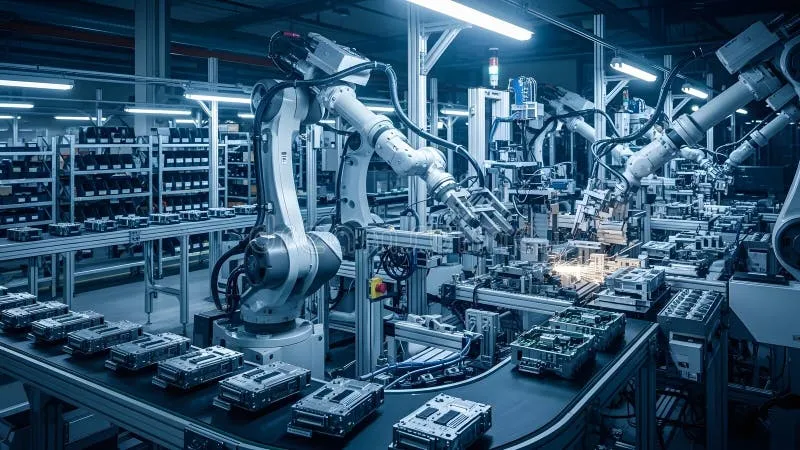
Photo: multiple industrial robots working together manufacturing automation coordination, via thumbs.dreamstime.com
For most of industrial robotics history, the dominant paradigm has been singular: one robot, one task, one controller. Machines were designed to excel in isolation, optimized for a specific motion, a defined payload, a repeatable sequence. Coordination, when it existed at all, was managed by human supervisors or rigid programmatic schedules that left little room for adaptation.
That paradigm is shifting. Across manufacturing facilities from the Pacific Northwest to the Gulf Coast, engineers are deploying multi-robot systems capable of communicating directly with one another, distributing tasks autonomously, and adjusting collective behavior in response to real-time conditions. The implications for throughput, flexibility, and operational complexity are substantial.
The Architecture Behind Robot Coordination
At the foundation of any multi-robot system is a communication protocol—the shared language that allows machines to exchange state information, issue requests, and respond to one another's actions. Several frameworks have emerged as leading candidates for industrial deployment.
ROS 2 (Robot Operating System 2) remains one of the most widely adopted platforms in the developer community, offering a publish-subscribe messaging architecture that allows multiple nodes—including individual robots—to exchange data across a shared network. Its real-time capabilities and improved security model over the original ROS have made it a practical choice for production environments where latency and reliability are non-negotiable.
For facilities requiring tighter integration with existing industrial control infrastructure, OPC UA (Open Platform Communications Unified Architecture) provides a vendor-neutral, platform-independent communication standard that bridges robotics systems with programmable logic controllers, SCADA systems, and enterprise software. Its built-in security and semantic data modeling capabilities address concerns that have historically slowed adoption of open protocols on plant floors.
MTConnect, developed specifically for manufacturing equipment, offers a standardized data vocabulary that allows disparate machines—including robots from different manufacturers—to report operational data in a consistent format. For facilities managing heterogeneous fleets, this interoperability is not a convenience; it is a prerequisite.
Swarm Logic in an Industrial Context
The conceptual framework most frequently invoked in discussions of multi-robot coordination is swarm robotics—systems in which simple individual behaviors produce complex, adaptive collective outcomes without centralized control. The inspiration comes from biology: ant colonies, bird murmurations, bee swarms.
Industrial implementations are more structured than biological swarms, but the underlying principle—that decentralized, locally-informed decision-making can outperform centralized command-and-control in dynamic environments—is finding genuine application on American factory floors.
Consider a fulfillment center where a fleet of autonomous mobile robots (AMRs) manages inventory transport. In a centralized model, a single warehouse management system assigns each robot a task, monitors its progress, and issues new assignments upon completion. This approach works, but it creates a bottleneck: all decisions flow through a single point, and the system's responsiveness is constrained by the speed and availability of that central controller.
In a more distributed model, robots share real-time location and status data with one another and apply local decision rules to resolve conflicts, reroute around obstacles, and claim available tasks from a shared queue. The central system sets priorities and constraints; the robots negotiate the details among themselves. The result is a more resilient, adaptive system that degrades gracefully when individual units encounter problems.
"The moment you stop thinking of each robot as a discrete asset and start thinking of the fleet as a single system, your design decisions change completely," noted one automation architect who has deployed multi-robot systems for several large US manufacturers. "The communication layer isn't secondary infrastructure—it's the core of what makes the system work."
Task Allocation and Autonomous Negotiation
One of the most technically demanding aspects of multi-robot coordination is task allocation: determining which robot should perform which task, and when. In static environments with predictable workloads, this can be handled by pre-programmed schedules. In dynamic production environments, it requires something more sophisticated.
Auction-based allocation algorithms have gained traction as a practical approach. When a task becomes available, robots submit bids based on their current state—proximity to the task location, remaining battery capacity, current workload—and the task is assigned to the highest-bidding (or lowest-cost) candidate. This mechanism distributes work efficiently without requiring a central system to maintain detailed awareness of every robot's condition at every moment.
Behavior trees and finite state machines provide the logical scaffolding that governs individual robot responses to incoming task assignments, status changes from peers, and environmental events. When combined with shared data infrastructure, these tools allow engineers to define coordination policies that are both structured and flexible—robots follow consistent rules while retaining the ability to adapt to novel situations.
Coordination in Complex Assembly
Perhaps the most compelling demonstration of multi-robot coordination is in complex assembly tasks that exceed the physical or cognitive capabilities of any single machine. Large aerospace components, automotive body structures, and industrial equipment often require simultaneous manipulation from multiple positions—a task that demands precise synchronization between cooperating robots.
Dual-arm and multi-arm robotic systems have addressed some of these challenges within a single platform, but coordinating physically separate robots on a shared workpiece introduces additional complexity. Each robot must maintain awareness of its counterparts' positions and forces, adjusting its own behavior to prevent interference and ensure the collective manipulation achieves the intended outcome.
Force and torque sensing, combined with high-frequency data exchange between cooperating robots, enables the kind of compliant, responsive coordination that these tasks require. Research groups at institutions including MIT, Carnegie Mellon, and several national laboratories have published promising results in this area, and commercial deployments—particularly in automotive and aerospace manufacturing—are beginning to follow.
Security and Reliability Considerations
Expanding the communication surface of a manufacturing system introduces risk. Every data exchange between robots represents a potential vector for interference, whether from network failures, malicious actors, or unintended interactions between system components. Engineers designing multi-robot communication architectures must weigh the benefits of connectivity against the imperative to maintain operational integrity.
Encrypted communication channels, authentication mechanisms for robot-to-robot messages, and fail-safe behaviors that allow individual robots to operate safely in the absence of peer data are all essential design considerations. The OPC UA standard's built-in security architecture addresses several of these concerns at the protocol level, which has contributed to its adoption in security-conscious industrial environments.
Redundancy in communication infrastructure—ensuring that no single network failure can disable coordination across an entire fleet—is equally important. Facilities deploying mission-critical multi-robot systems are increasingly treating their communication networks with the same reliability engineering discipline applied to physical hardware.
The Coordination Dividend
The case for investing in robot-to-robot communication infrastructure is increasingly supported by operational data. Facilities that have transitioned from isolated robot deployments to coordinated multi-robot systems report measurable gains in throughput, reductions in idle time, and improved adaptability to production schedule changes.
More significantly, coordinated multi-robot systems are enabling manufacturing capabilities that simply were not achievable with isolated machines. Tasks that required human coordination—managing handoffs between work cells, responding dynamically to production bottlenecks, executing complex multi-point assembly operations—are increasingly being performed by robot teams operating with minimal human supervision.
For American manufacturers competing in an environment of rising labor costs, persistent workforce shortages, and accelerating demand for product customization, that capability is not a future aspiration. It is an operational necessity taking shape on production floors today.