Precision Is Overrated: How Relaxing Calibration Standards Is Making American Robots More Reliable
For decades, the prevailing orthodoxy in industrial robotics held that tighter was always better. Tighter tolerances. Tighter calibration windows. Tighter repeatability specifications printed in bold on every vendor data sheet. The assumption was straightforward: the closer a robot's real-world behavior matched its theoretical model, the better it would perform on the production line.
That assumption is now being openly challenged—and the engineers doing the challenging have the deployment data to back them up.
Across automotive plants in Michigan, fulfillment centers in Texas, and precision assembly operations in California, a growing number of robotics teams are reporting an uncomfortable truth: obsessing over calibration perfection frequently makes their systems more fragile, not more capable. The robots that thrive in messy, variable production environments are often the ones whose engineers were willing to accept a little imprecision at the outset and let smarter software handle the rest.
The Engineering Cost of Chasing Perfect Numbers
Calibration is not a one-time event. Every articulated arm, vision-guided picker, and mobile manipulator deployed on an American factory floor will drift over time. Thermal expansion, mechanical wear, vibration, and even humidity changes conspire to pull a robot's real-world behavior away from its calibrated baseline. The traditional engineering response to this reality has been to define very tight acceptable deviation bands and schedule frequent recalibration cycles to keep systems within those bands.
The problem is that this approach carries substantial hidden costs. Recalibration requires downtime. It demands skilled technicians who are already in short supply across the US manufacturing sector. And in facilities running multiple shifts, finding windows for recalibration without disrupting throughput is itself a logistical engineering challenge.
Worse, extremely tight calibration tolerances can create brittle systems. A robot calibrated to sub-millimeter perfection under controlled conditions may struggle badly the moment ambient temperature shifts by ten degrees or a worn conveyor introduces slight positional variability in incoming parts. The system was engineered to be perfect, not resilient.
"We spent months dialing in specifications that looked great in the integration lab and fell apart within two weeks on the floor," said one process engineer at a Midwest automotive components supplier who asked not to be identified by name. "The environment doesn't care about your tolerance stack-up."
The 'Good Enough' Window and Why It Works
The alternative approach gaining momentum among forward-thinking robotics teams is sometimes called calibration windowing—deliberately defining acceptable performance ranges that are wider than strict theoretical optima, then relying on adaptive control algorithms and real-time sensor feedback to manage variability within those ranges.
The logic is straightforward. If a robot's positioning accuracy needs to be within two millimeters for a given assembly task, engineering the system to maintain 0.2-millimeter calibration fidelity at all times creates a tenfold margin that serves no practical purpose. That margin demands expensive maintenance to preserve and introduces failure modes whenever the system drifts outside its artificially tight band.
By contrast, a system calibrated to a more generous but still task-appropriate window—and equipped with vision systems or force-torque sensors that can compensate for positional variation in real time—may deliver equivalent or superior outcomes with significantly less maintenance burden.
This philosophy aligns with broader trends in adaptive robotics, where machine learning models trained on real production data increasingly handle the micro-corrections that rigid calibration protocols once attempted to eliminate entirely.
Case Study: Throughput Gains From Letting Go
One publicly documented example comes from a large-scale e-commerce fulfillment operation that deployed a fleet of vision-guided picking robots across several distribution centers. Initial deployment specifications called for aggressive recalibration schedules tied to strict positional accuracy thresholds.
After observing that recalibration events were accounting for a disproportionate share of system downtime—and that post-calibration performance gains were often marginal—the engineering team ran a controlled comparison. One group of robots was maintained under the original strict schedule. A second group was allowed to operate within wider calibration windows, supported by enhanced real-time visual correction algorithms.
The results, presented at an internal engineering review, showed that the second group achieved higher average uptime and comparable pick accuracy. The maintenance labor associated with that group dropped by more than thirty percent over a six-month period. The robots were, by conventional standards, less precisely calibrated. They were also more productive.
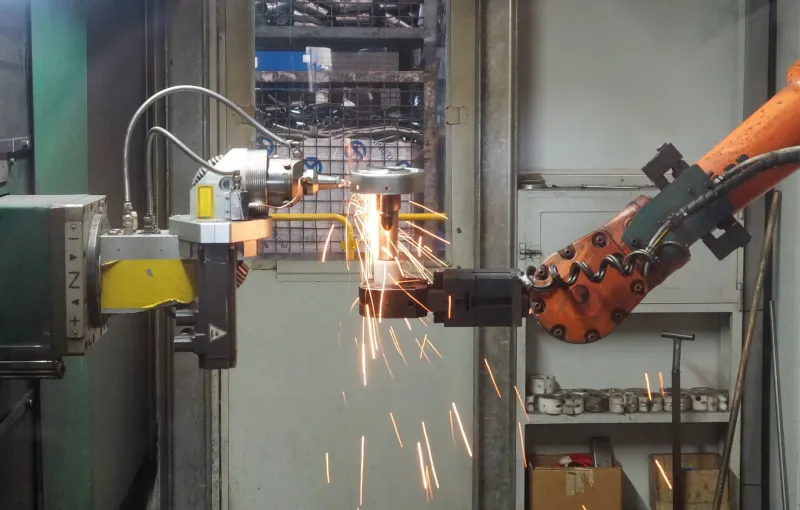
Similar outcomes have been reported anecdotally across automotive welding applications, where adaptive seam-tracking systems have reduced the frequency of full kinematic recalibrations without measurable quality degradation.
The Role of Adaptive Algorithms in Filling the Gap
None of this works without capable software absorbing the variability that looser calibration windows introduce. Modern adaptive control systems—particularly those incorporating iterative learning control, Bayesian estimation, and neural-network-based correction layers—are increasingly capable of compensating for the kind of drift and positional variation that once required human recalibration to address.
The practical implication is a meaningful shift in where engineering effort is directed. Rather than investing heavily in maintaining a pristine calibration state, leading teams are investing in the quality and robustness of their adaptive correction layers. The calibration baseline becomes a starting point rather than a constant target.
This shift also changes the skill profile demanded of field engineers. The technician who previously spent hours with a laser tracker and calibration artifacts is giving way to a software-oriented engineer who monitors algorithm performance, evaluates sensor data quality, and tunes correction models. It is a transition that reflects the broader digitization of the American manufacturing floor.
Rethinking the Specification Sheet
Perhaps the most significant implication of this trend is what it demands of the way robotics engineers write and evaluate specifications. Positioning accuracy figures on vendor data sheets are typically measured under ideal, static conditions that bear limited resemblance to real production environments. Specifying systems based on these numbers without accounting for real-world variability and the role of adaptive software is, increasingly, an engineering error.
The more sophisticated approach involves specifying task-level performance outcomes—part placement accuracy, cycle time consistency, defect rates—and then designing the calibration and adaptive control architecture to meet those outcomes under realistic operating conditions. Whether the robot's kinematic calibration is perfect at any given moment becomes largely irrelevant if the overall system reliably delivers the required result.
This reframing does not diminish the importance of calibration as an engineering discipline. It redefines its purpose: not to achieve a theoretical ideal, but to establish a sufficient baseline from which adaptive systems can operate effectively.
The Practical Takeaway for Robotics Teams
For engineers and developers currently specifying or maintaining robotic systems, the central lesson is worth stating plainly. Time and budget spent chasing calibration perfection beyond what a given task actually requires is time and budget that could be invested in more capable sensing, better adaptive algorithms, or broader system coverage.
The robots winning on American production floors today are not necessarily the most precisely calibrated machines in the facility. They are the most resilient—the systems designed to handle variability gracefully rather than to pretend variability does not exist.
In that sense, the calibration paradox is not really a paradox at all. It is a maturation of engineering judgment: the recognition that in complex, real-world deployments, robustness and adaptability outperform perfection every time.